December 29, 2025
The Impact of Not Saving the Bleeding Automotive Industry
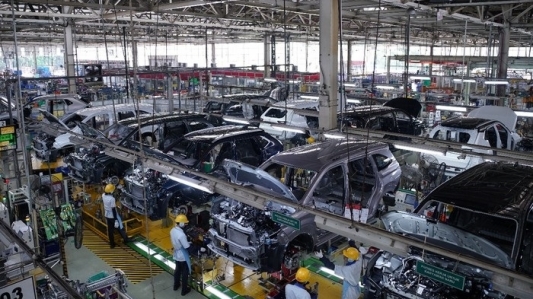
The Indonesian automotive industry is not doing well. Consumer purchasing power for new vehicles is weakening. Sales have plummeted compared to last year. The impact will be dire if the automotive industry is not rescued.
According to data from the Association of Indonesian Automotive Industries (Gaikindo), cumulative wholesale sales (distribution from factories to dealers) from January to November 2025 reached 710,084 units. This compares to 785,917 units for the same period last year. This represents a market decline of 9.6 percent.
Retail sales (sales from dealers to consumers) reached 739,977 units during the first 11 months of this year. This compares to 807,586 units during the same period last year, a decrease of 8.4 percent.
Amid the sluggish Indonesian automotive market this year, the government plans to discontinue incentives for the automotive industry. Recently, Coordinating Minister for Economic Affairs Airlangga Hartarto revealed that the incentives currently enjoyed by several manufacturers will not continue in 2026. Airlangga said that the budget previously allocated for electric car incentives will be diverted to the development of a national car.
"Where will the electric car incentive budget be diverted? We certainly have a national car plan (focused on the national car - Ed.), so we can actually learn from VinFast," said Airlangga.
Vice President Director of PT Toyota Motor Manufacturing Indonesia (TMMIN), Bob Azam, stated that Indonesia currently has a vehicle production capacity of 2.3 million units. However, of that annual production capacity of over 2 million units, only half is utilized. This year alone, vehicle production for the domestic market is projected at only 800,000 units, plus exports of 500,000 units, for a total production of only 1.3 million units, out of a total capacity of 2.3 million units.
"So, it's approaching 50 percent utilization, and this is certainly not a good figure for the industry because if the break-even point is 50 percent, it's already close to break-even point. If it runs below break-even point, we worry about labor efficiency in the automotive sector," Bob said, as quoted by CNBC Indonesia.
"Of course, this is something we don't want. So, going forward, the automotive industry must be encouraged to grow. Why? Because the automotive industry absorbs a lot of labor. It's also export-oriented, and these exports have high added value because of the technology involved. So, it deserves support. In fact, in many countries, including Indonesia, the automotive industry is a leading economic indicator. It shows how our economy is going to develop in the future. So that's our concern for next year, so that the automotive industry can be encouraged and supported," he continued.
Investors Could Turn to Neighbors
Bob also worries that if the struggling automotive industry isn't 'saved,' investors will flee. He fears investors will flee to neighboring countries like Malaysia.
"Because this investment is closely monitoring market developments. So if the market grows, investment will come in. But if the market continues to decline, investment will withdraw," he said.
"This is what I'm worried about: by 2025, domestic automotive sales in Indonesia may be equal to those in Malaysia. If this situation continues, investment will go to Malaysia, not Indonesia. Yes, that's what we must all pay attention to," he continued.
The Malaysian Automotive Association (MAA) recently released data on motor vehicle sales in the country. Cumulatively, from January to November 2025, car sales in Malaysia reached 727,836 units. This figure is a slight decrease, only 1.15 percent compared to the same period the previous year, which recorded 736,317 units.
Comparatively, the decline in car sales in Indonesia is much deeper than in Malaysia. Automotive retail sales in Indonesia fell 8.4 percent from January to November 2025. Meanwhile, in Malaysia, the decline was only 1 percent.